Automotive websites and digital products
Automotive website design and development in India
By Rakesh Purohit, Chief Technology Officer, ibs Fulcro · Reviewed 21 November 2026
Help buyers explore a vehicle, choose a dealer and request a test drive in one connected journey. We design and build automotive websites with vehicle configurators, dealer information and enquiry routing planned together.
In short- Our automotive work includes websites and digital products for Tata Motors, Bajaj Auto and JK Tyre. For Tata Motors, that spans passenger vehicle journeys, the Harrier Special Edition microsite, owner communities and EV route planning.
- The Tata Motors passenger vehicle rebuild produced a 10x increase in monthly leads, after a customer journey audit, a configurator-led rebuild and an enquiry-form redesign.
- Our work also extends to the dealer handoff. Tata Motors licenses our Fulcro Lead Orchestrator platform, which brings together five lead sources and handles 1.2 million leads a month.
- We structure dealer and outlet records, agree territory rules and plan what happens when an enquiry needs follow-up. Your teams keep dealer information current as the network changes.
- Planning an automotive website? Configurator-led sites with dealer integrations fall within our ₹60 lakh–₹2 crore enterprise range. Share your brief and launch date at [email protected] so we can discuss the scope.
What does an automotive website need to get right?
The buyer sees one journey, from exploring a model to contacting a dealer. Behind it, vehicle data, outlet information and sales systems need to work together. We plan those connections alongside the website experience.
Show the right vehicle options. A configurator needs consistent information about variants, colours, trims, accessories and valid combinations. We map that data and the required imagery before designing how buyers explore their choices.
Work back from the model launch. We plan development, content delivery, approvals and testing around the launch calendar, so dependencies are visible while there is time to address them.
Our automotive websites and digital products
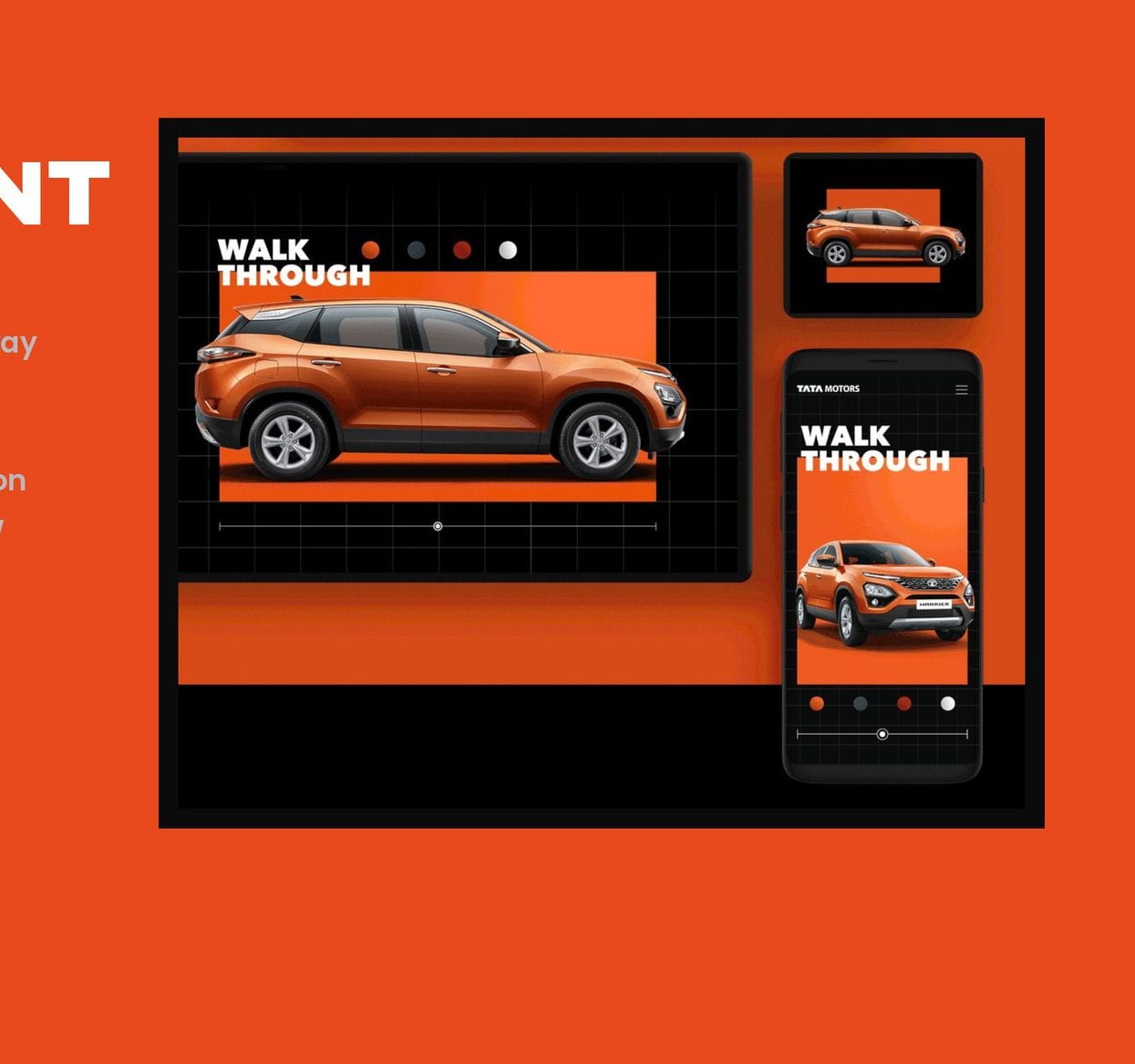
Website buildTata Motors Harrier Special Edition
Campaign microsite with an interactive colour configurator
We built a Harrier Special Edition microsite where visitors could rotate the vehicle and explore its colours, then find a nearby dealer and request a test drive.
Read the case study › 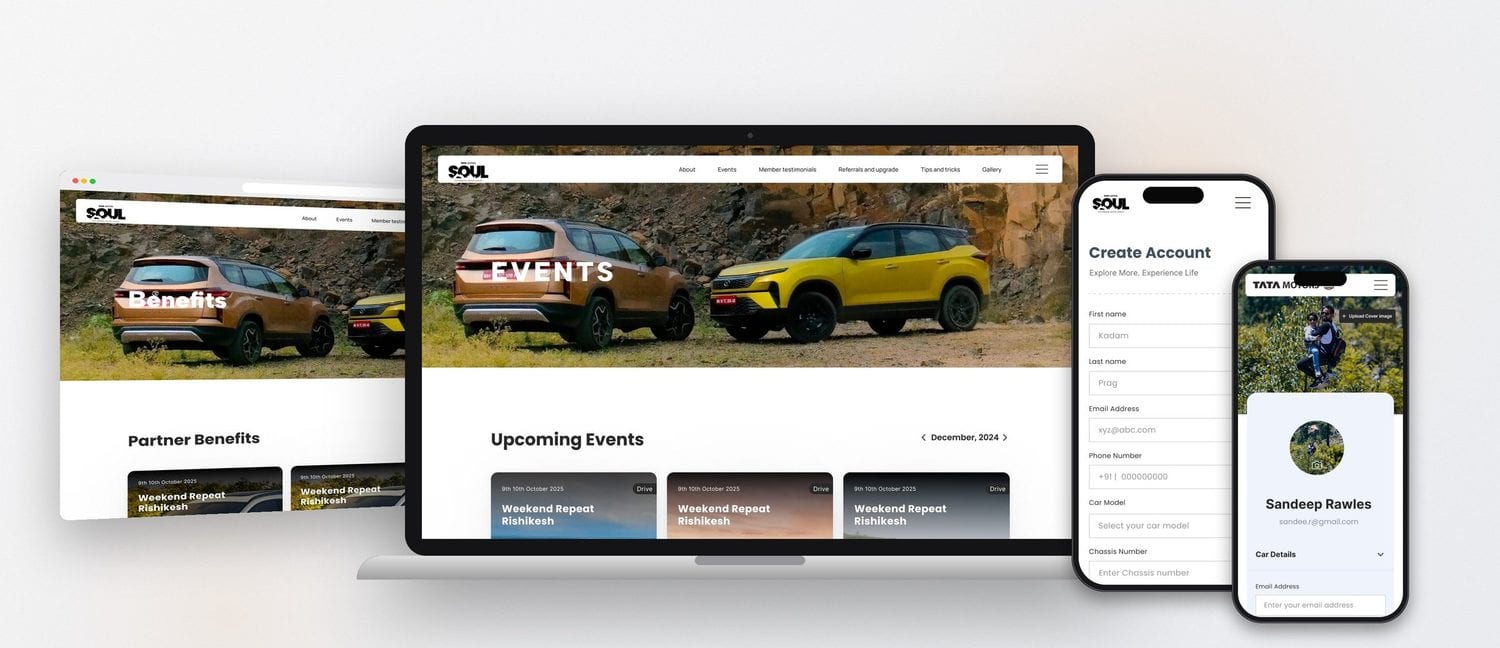
Website buildTata Motors SOUL
Owners’ community connected to Tata’s CRM
We built the SUV Owners United League (SOUL) platform for Harrier and Safari owners. Membership verification connects to Tata’s CRM, linking community access to vehicle ownership.
Read the case study › Website buildTata Motors passenger vehicles
Customer journey rebuild and conversion rate optimisation
10xIncrease in monthly leads
We audited the customer journey across Tata Motors’ passenger vehicle websites, then rebuilt it around a modular configurator and redesigned enquiry form. Monthly leads increased 10x.
Read the case study › Website buildTata Motors Evolve
Community platform for EV owners
50xIncrease in event participation
We built Evolve around the interests and questions of EV owners, with events, forums, engineer podcasts and a referral programme. Event participation grew 50x.
Read the case study › Digital productTata Motors EV Route Planner
Route planning for electric vehicle drivers
100,000Routes planned
We built the EV Route Planner to help drivers plan journeys and understand their charging needs. The tool has been used to plan 100,000 routes.
Read the case study › Website buildJK Tyre
Website development
We developed a website for JK Tyre.
Our automotive work also includes lead management and website audits.
Lead management and automotive audits
Tata Motors: Our Fulcro Lead Orchestrator platform brings together five lead sources and handles 1.2 million leads a month.
JK Tyre: We carried out an answer engine optimisation (AEO) audit covering 12,651 unique prompts.
Goodyear India: We conducted a web experience audit, mapped journeys for five customer personas and developed a prototype.
Dealer locators that connect buyers to your sales network
A useful dealer locator helps someone find an appropriate outlet and contact it. We build the dealer records, enquiry handoff and routing rules together so the selected location carries through the journey.
- Dealer and outlet records. We distinguish the dealer business from its individual showrooms, service centres and used-car outlets. Each location carries its own opening hours, services and territory.
- Territory and assignment rules. Where outlets serve the same area, we agree how an enquiry is assigned. Rules use proximity, rotation, capacity or other criteria that fit your sales process and data.
- A connected enquiry form. The buyer’s selected outlet carries into the form and lead routing, so they can continue without choosing the same location again.
- Response tracking and escalation. We build agreed response-time targets and escalation rules into the lead flow, helping your team identify requests that need attention.
- Updates managed by your team. Authorised regional teams maintain outlet information as locations open, move or close, without waiting for a developer to edit the website.
How we build an automotive website
Our eight-step process takes the project from an audit of the existing site through to launch and ongoing improvements. On an automotive build the audit usually starts on the existing configurator and enquiry form, and the post-launch step reports against lead volume and dealer response time.
- Behavioural audit. We analyse the existing site using Hotjar or Microsoft Clarity to record heatmaps, scroll maps, visitor recordings and form analytics. This helps us identify UX bottlenecks such as where people stop, what they never reach, and which fields cause form drop-offs.
- UI and UX. We build a concept prototype first to put the shape of the journey in front of people quickly, then wireframe to fix the structure and the template set. We run user testing on the wireframes, while changing them is still cheap.
- Design in Figma. We design in Figma against the agreed template set, covering the states that get skipped: empty, loading, error, and the form after a failed submit. We then build a high-fidelity prototype, so what goes to development has already been clicked through.
- Development. We build the frontend and the CMS together on a named stack, in a repository you own from the first commit. We implement Core Web Vitals, structured data and AI search visibility at this step.
- QA and VAPT. We run functional and cross-device QA, then VAPT (Vulnerability Assessment and Penetration Testing) on the build. We check consent handling, data storage and retention against the DPDP Act (Digital Personal Data Protection Act) and, where you have European users, GDPR.
- Deployment. We hand over the repository, the documentation and the deployment pipeline. You can take all three to another vendor.
- Analytics, A/B testing and CRO. We deploy measurement with the site, then run A/B tests against the behaviour the audit found and work through CRO (Conversion Rate Optimisation) on the journeys that carry the revenue. We report against the same metrics the audit used, so the before and after are comparable.
- Ongoing enhancements and content authoring. We run enhancements on a monthly cycle and author content where your team wants the pages written as well as published. The maintenance retainer covers both.
How much does an automotive website cost?
A new website build starts at ₹10 lakh. Enterprise projects range from ₹60 lakh to ₹2 crore, depending on technology, integrations and scope. The full enterprise workflow includes an audit, UX and UI design, user testing, CMS development, agreed integrations and post-launch conversion optimisation.
A focused campaign microsite sits at the lower end of our rate card. A configurator-led vehicle website with dealer data and lead routing falls within the enterprise range. The final quote depends on the features, content and systems involved.
Automotive website development: common questions
Which automotive brands have you worked with?
Our website and digital-product work includes Tata Motors, Bajaj Auto and JK Tyre. Tata Motors projects include the passenger vehicle journey rebuild, Harrier Special Edition microsite, SOUL, Evolve, Easy to EV and the EV Route Planner. We also conducted a web experience audit for Goodyear India and an AEO audit for JK Tyre.
Can you build a dealer locator connected to our enquiry forms?
Yes. We build the dealer and outlet records, location selection and lead routing as a connected flow. The selected outlet carries into the enquiry form, and agreed territory rules determine where the request is sent.
Can you work to our model launch calendar?
Yes. We plan the website work alongside content delivery, approvals and testing against your target launch date. We agree the scope and dependencies early so your team can see what needs to be ready and when.
How long does a website build take?
A new website build takes 2 to 3 months. An enterprise website with the full workflow takes 6 to 9 months, with a partial release at 3 months. These timelines assume a named single point of contact on your side who gives feedback and approvals promptly, with every response within 2 business days.
Do you build vehicle configurators?
Yes. Our Harrier Special Edition microsite included an interactive colour configurator, and the Tata Motors passenger vehicle rebuild was configurator-led. We agree the required options, data sources and integrations for each project.
What budget should we allow for an automotive website?
For a configurator-led website with dealer integrations, our enterprise range is ₹60 lakh–₹2 crore, depending on scope. A new website build starts at ₹10 lakh, while campaign microsites are scoped to their requirements. Monthly support and content authoring starts at ₹75,000.
What are the contract and cancellation terms?
Contracts run 12 months, and either party can cancel on one month’s notice.
Let’s discuss your automotive website
Email [email protected] with your website address, what you want to improve and any launch date you are working towards. If you have a brief, send it along. We’ll discuss the requirements and the next step.